Overview
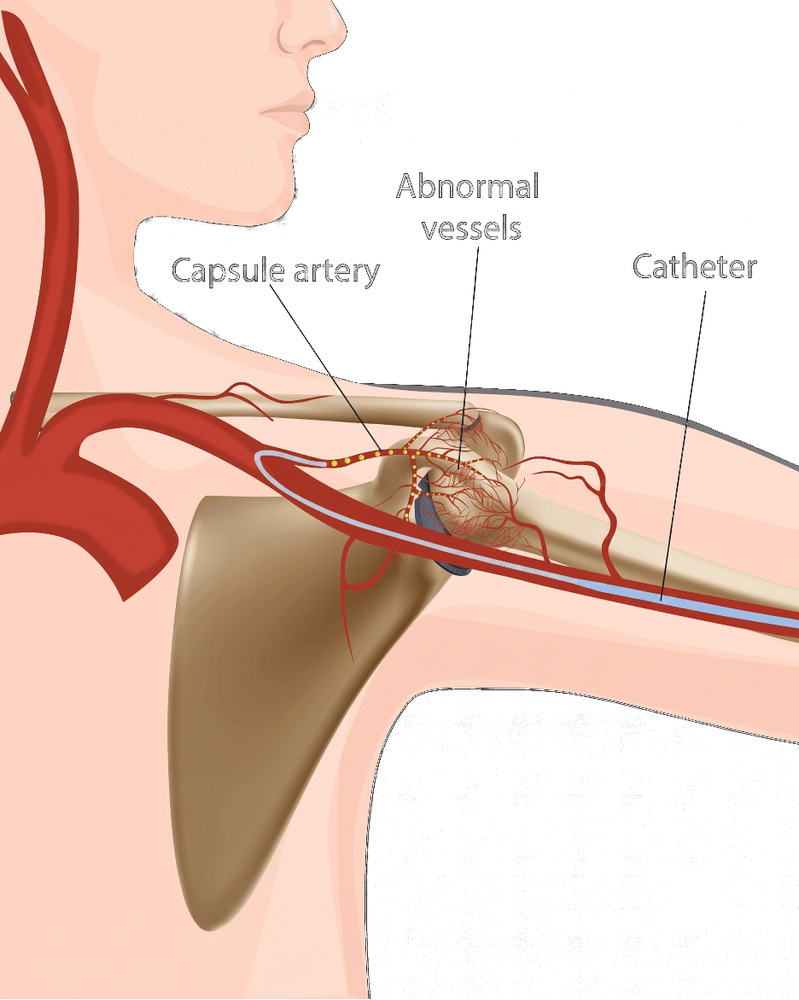
A frozen shoulder (adhesive capsulitis) or chronic shoulder osteoarthritis can cause severe, debilitating pain and stiffness. This happens when chronic inflammation drives the growth of abnormal new blood vessels in the shoulder joint capsule. Those new vessels bring tiny new nerve endings with them, and those nerve endings are highly sensitive, causing constant pain.
Shoulder embolization, also called shoulder artery embolization (SAE) or transcatheter arterial embolization, is a minimally invasive procedure that safely blocks these abnormal, pain-causing blood vessels.
It replaces the need for repeated steroid injections or invasive arthroscopic surgery. It also offers a breakthrough for patients who have plateaued in physical therapy because their pain is simply too severe to perform the necessary stretches and exercises.
Embolization stops the cycle of inflammation at its source, significantly reducing pain and allowing you to regain your shoulder’s range of motion without major surgery or a long recovery.
Who it’s for
Most patients considering this procedure come to the clinic after months of a stiff, painful shoulder. They typically have a diagnosis of frozen shoulder or shoulder osteoarthritis and have already tried physical therapy, anti-inflammatory tablets, or cortisone injections without lasting relief.
An MRI or ultrasound is often used to rule out other causes of pain and to confirm that abnormal blood vessel growth is present, which is what makes you a good candidate for the procedure.
Who is not a candidate
If your shoulder pain is caused by a complete, acute tear of the rotator cuff, an active joint infection, or severe bone-on-bone arthritis that requires a total shoulder replacement, embolization is not the right treatment. In those cases we work closely with orthopedic specialists to make sure you receive the correct surgical care.
How the procedure works
1. Accessing the artery
An interventional radiologist cleans and numbs a small area at the wrist, on the same side as the shoulder pain. A tiny tube called a catheter, about the width of a piece of spaghetti, is inserted through a small needle puncture access into the artery.
2. Navigation and imaging
Using real-time X-ray guidance (fluoroscopy), the catheter is navigated through your blood vessels directly to the small arteries supplying the shoulder joint. You will not feel this happening inside your body.
3. Embolization: blocking the vessels
Once the catheter is precisely positioned near the abnormal, newly formed vessels, either crystallised antibiotic particles or tiny gel particles are injected. These wedge safely into the inflammatory vessels and block their blood flow, while leaving the healthy vessels intact.
4. Relief and restoration
Deprived of their blood supply, the inflamed tissue and the extra nerve endings begin to recede, breaking the cycle of pain. The catheter is removed and a simple bandage is applied.
What to expect on the day
When you arrive, our team will get you comfortable and start an IV. This is not a painful procedure, and it can be performed awake with local numbing alone. We may also provide “twilight” sedation if desired, in which case you will be relaxed and sleepy but breathing on your own, without a breathing tube or general anesthesia.
The procedure itself typically takes 45 minutes to an hour. Because there are no surgical incisions, you go home the same day.
You will rest in our recovery room for about an hour afterward.
Recovery
Recovery is highly manageable. On day one, plan to rest at home. You may have mild soreness at the wrist access site, and your shoulder may feel slightly achy. This is completely normal and is easily managed with over-the-counter pain relievers such as ibuprofen or acetaminophen.
By the end of the first week most patients feel back to their baseline. You can typically return to normal daily activities within two to three days. We ask that you avoid heavy lifting and strenuous exercise for about a week so the access site heals properly. As the pain subsides, your physical therapy exercises become much easier and more comfortable to perform.
What is normal, and when to call
Mild bruising at the entry site is completely normal. Call our office if you experience severe or worsening pain, a fever above 101°F, active bleeding at the access site, or any sign of infection.
Risks and considerations
Shoulder embolization is highly safe, but as with any procedure there are potential risks, and we would rather set them out plainly.
Common, minor side effects include bruising at the access site and temporary skin discolouration around the shoulder, which looks like a mild rash and resolves on its own within a few days.
Rare but more serious risks include infection, injury to the blood vessel, and non-target embolization, where the particles block blood flow to healthy tissue. Because the procedure is performed by a highly trained interventional radiologist using advanced, real-time imaging, the risk of major complications is extremely low. If any issue arises, our team is fully equipped to manage it safely.
Results and evidence
The clinical evidence supporting shoulder embolization for frozen shoulder and osteoarthritis is very promising. Studies show a technical success rate of nearly 100%, meaning the target arteries can almost always be reached and treated successfully.
For symptom relief, roughly 80% to 90% of patients experience a significant, rapid decrease in resting and night-time pain. Because the pain is relieved, patients are finally able to participate fully in physical therapy, which leads to a dramatic improvement in range of motion.
Early clinical registries show that these results are durable over time, allowing patients to regain their independence and quality of life.
Common questions
- Is it painful?
- The procedure is well tolerated. We numb the entry site with local anesthesia and may provide IV sedation if desired, and you will not feel the catheter inside your body. Afterward your shoulder may ache mildly for a few days, which is easily managed with over-the-counter pain medicine.
- Will insurance cover it?
- Coverage can vary, because shoulder embolization is a newer and highly specialised application of embolization. Some major carriers cover it once standard treatments such as steroid injections and physical therapy have failed, while others currently consider it investigational. Our office will work closely with your insurance provider to verify your exact benefits and out-of-pocket costs before you proceed.
- How soon will I notice a difference?
- Many patients notice a significant reduction in resting shoulder pain within the first one to two weeks. As the inflammation settles you will find it much easier to move your arm and to make meaningful progress in physical therapy, with continued improvement in mobility over the next one to three months.
- What happens if it doesn’t work?
- If you do not have adequate relief after a few months, we will re-evaluate your shoulder. And if embolization ultimately does not relieve your symptoms, it burns no bridges: you remain a full candidate for traditional orthopedic treatment, including arthroscopic surgery or a joint replacement if that becomes necessary.