Overview
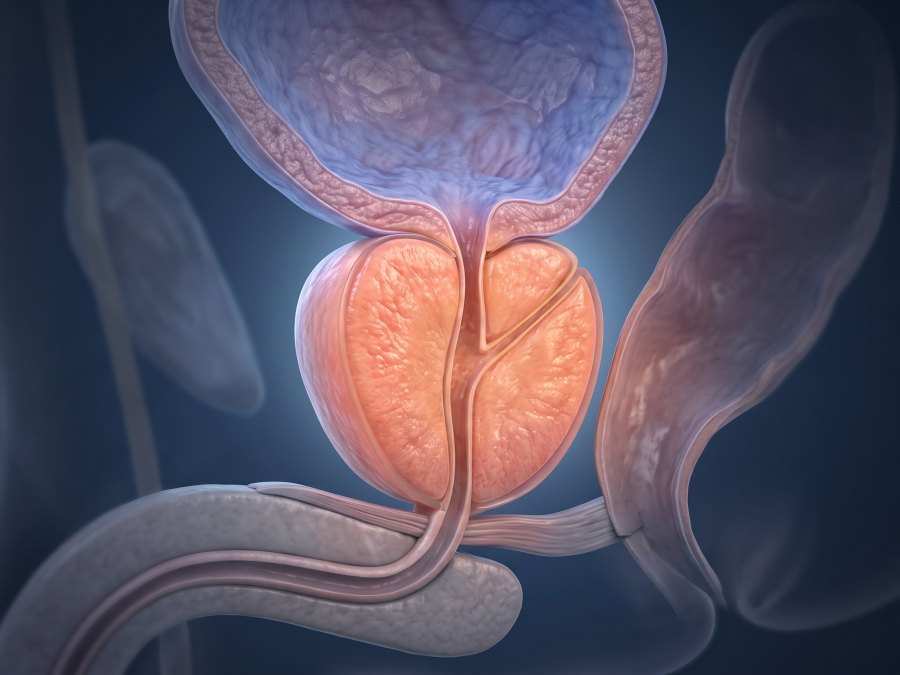
As men age, the prostate gland often grows larger. This condition, known as benign prostatic hyperplasia, or BPH, can squeeze the urethra and make urinating difficult or painful. Prostate artery embolization (PAE) is a minimally invasive procedure that safely shrinks the enlarged prostate by selectively blocking its blood supply.
It is a modern, less invasive alternative to traditional surgery such as TURP, which scrapes or cuts prostate tissue away through the penis. It also offers excellent relief for men who want to stop taking daily prostate medication because of unwanted side effects.
Embolization significantly improves urinary symptoms with a much lower risk of sexual side effects, such as erectile dysfunction or retrograde ejaculation, than traditional surgery carries. It requires no general anesthesia and no tissue removal, and it allows a fast recovery at home.
Who it’s for
Most men considering this procedure come to the clinic because an enlarged prostate is affecting their quality of life. Symptoms usually include a weak urinary stream, a frequent and urgent need to urinate, a feeling that the bladder is never fully empty, and waking several times a night to use the bathroom. Often these patients have already tried medication and are unsatisfied with the results or the side effects.
A physical exam, a symptom questionnaire, and imaging such as an ultrasound or MRI of the prostate are used to confirm the diagnosis and measure the size of the gland.
Who is not a candidate
If your urinary problems are caused primarily by prostate cancer, a neurogenic bladder (nerve damage affecting bladder control), or an active urinary tract infection, embolization is not the right treatment. In those cases we will direct you to the appropriate specialist for care.
How the procedure works
1. Accessing the artery
An interventional radiologist cleans and numbs a small area at the top of the thigh. A tiny tube called a catheter, about the width of a piece of spaghetti, is inserted through a small needle puncture access into the artery.
2. Navigation and imaging
Using real-time X-ray guidance (fluoroscopy), the catheter is navigated through your blood vessels directly to the small arteries that supply the prostate. You will not feel this happening inside your body.
3. Embolization: blocking the flow
Once the catheter is precisely positioned, small gel particles, calibrated to the size of the prostate vessels, are injected into the prostate arteries. The particles wedge into the vessels and safely block the blood flow.
4. Shrinkage and relief
Deprived of its full blood supply, the enlarged prostate tissue softens and shrinks over the following weeks. That relieves the pressure on the urethra and allows urine to flow normally again. The catheter is removed and a simple bandage is applied.
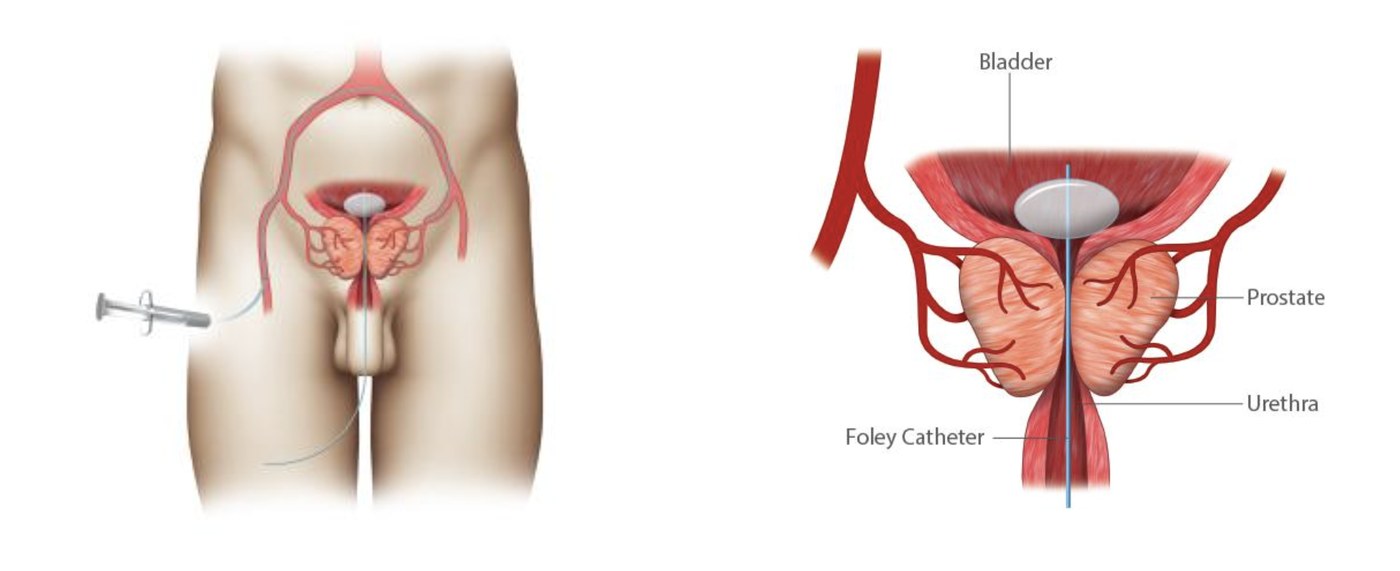
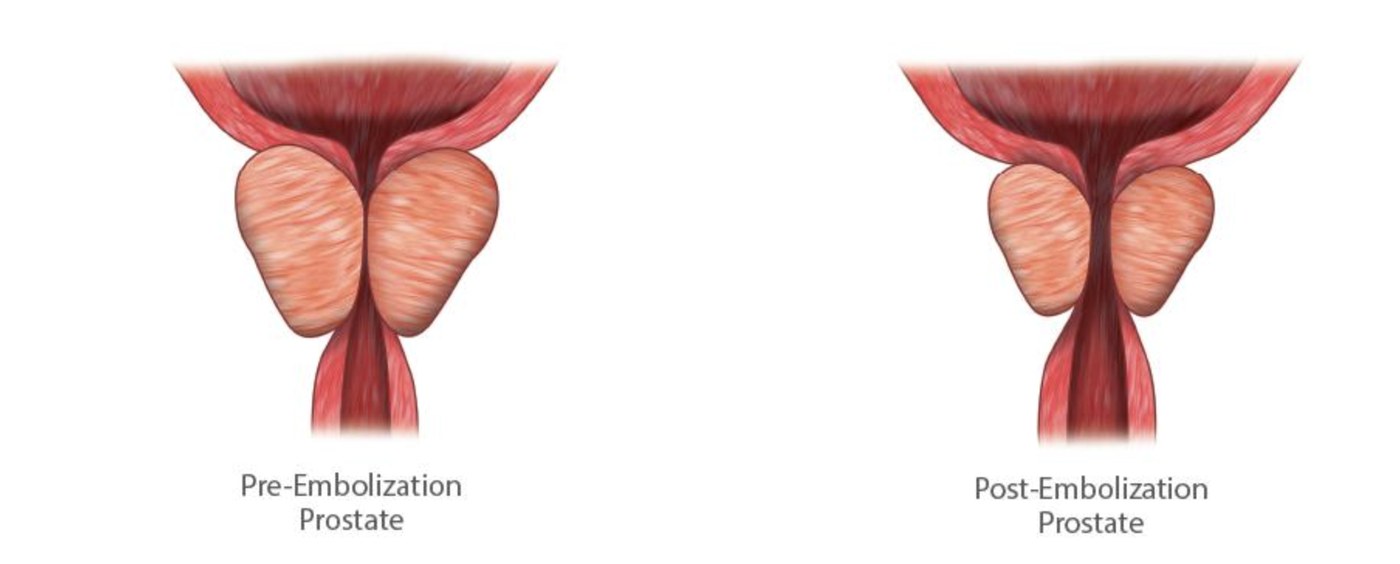
A short animation walking through the procedure step by step.
What to expect on the day
When you arrive, our team will get you comfortable and start an IV. This is not a painful procedure, and it can be performed awake with local numbing alone. We may also provide “twilight” sedation if desired, in which case you will be relaxed and sleepy but breathing on your own, without a breathing tube or general anesthesia.
The procedure itself typically takes 45 minutes to an hour. Because there are no surgical incisions, you go home the same day.
You will rest in our recovery room for about an hour afterward.
Recovery
Recovery is highly manageable. On day one, plan to rest at home. It is very common to experience what is known as post-PAE syndrome for the first few days: mild pelvic cramping, or a temporary burning sensation and increased frequency when urinating. These symptoms mean the procedure is working, and they are easily managed with over-the-counter pain relievers and medication we prescribe to relax the bladder.
By the end of the first week most patients feel back to their baseline. You can typically return to a desk job or normal daily activities within two to three days. We ask that you avoid heavy lifting and strenuous exercise for about a week so the access site heals properly.
What is normal, and when to call
Mild pelvic discomfort and temporary changes in urination are completely normal. Call our office if you experience severe or worsening pain, a fever above 101°F, active bleeding at the access site, or a complete inability to urinate.
Risks and considerations
Prostate artery embolization is very safe, but as with any procedure there are rare potential risks.
Common, minor side effects include bruising at the access site and a few days of pelvic ache or frequent urination as the prostate begins to shrink.
Rare but more serious risks include infection, injury to the blood vessel, and non-target embolization, which happens if the microscopic particles block blood supply to a nearby organ such as the bladder or rectum. Because the procedure is performed by a highly trained interventional radiologist using advanced, real-time imaging, the risk of non-target embolization is extremely low, under 0.5%. If it does occur it may be uncomfortable for a few days, but it is usually self-limited and heals on its own.
Results and evidence
Dr. Golowa is one of the most experienced specialists in the country for prostate artery embolization, having performed over 1,000 of these procedures. He also helped pioneer PAE in the United States.
The clinical evidence supporting PAE is extensive and still growing. Studies show a technical success rate of over 95%, meaning the targeted arteries can almost always be blocked successfully.
For symptom relief, more than 90% of men experience significant improvement in urinary flow and a major reduction in daily symptoms. The prostate typically shrinks by about 40% to 50% over the first six months.
One of the most important proven benefits of PAE is the preservation of sexual function. Unlike traditional surgery, which carries a high rate of retrograde ejaculation (dry orgasm) and erectile dysfunction, PAE has been shown to protect and preserve these functions in the vast majority of patients.
Common questions
- Is it painful?
- The procedure is well tolerated. We numb the entry site with local anesthesia and may provide IV sedation if desired, and you will not feel the catheter inside your body. Afterward it is very common to have mild pelvic cramping and a frequent urge to urinate for a few days. We provide medication to keep you comfortable at home while that resolves.
- Will insurance cover it?
- Yes. Prostate artery embolization is a recognised, medically necessary treatment for benign prostatic hyperplasia, and it is covered by Medicare and most major private insurance carriers. Our office will help you verify your exact benefits and coverage before you proceed.
- How soon will I notice a difference?
- Unlike traditional surgery, which gives immediate but often painful results, PAE takes a little time to work because the prostate shrinks gradually. Most men begin to notice a clearer urinary stream and fewer trips to the bathroom within two to three weeks, with continued improvement over the next three to six months.
- Will I need a urinary catheter to go home?
- In the vast majority of cases, no. One of the biggest advantages of prostate artery embolization is that it is exceedingly rare to need a urinary catheter afterward. Most men are able to urinate on their own in our recovery room and go home without any tubes. If you already have a catheter in place because of a severe blockage, it will typically stay in for another week or two while the prostate shrinks, after which your urologist can safely remove it.
- What happens if it doesn’t work?
- If you do not have adequate relief after a few months, we will re-evaluate your prostate. In some cases it has secondary blood supplies that need to be addressed. And if PAE ultimately does not relieve your symptoms, it burns no bridges: you remain a full candidate for traditional urological surgery such as TURP or laser treatment.
Further reading
Venous leak: why you can get an erection but not keep it
A cause of ED that shows up when blood drains away too fast, and why medication often fails to fix it.