Overview
A venous leak, also known as veno-occlusive dysfunction, happens when the veins in the penis cannot properly trap blood during an erection. Even if blood flow in is strong, these faulty veins let it drain out too quickly, making an erection difficult or impossible to maintain.
Venous leak embolization is a minimally invasive procedure that closes off the leaking veins from the inside, so normal erectile function can be restored.
It offers a more effective and less invasive alternative to open venous ligation surgery, which involves larger incisions and a longer recovery. It is also an option for men who have tried medications such as Viagra or Cialis without success. Those drugs increase blood flow into the penis but cannot stop it leaking out.
Embolization addresses the physical root of the problem without major surgery, requiring only a tiny needle puncture in the skin, and allows most men to return to normal activity within a few days.
Who it’s for
Most men considering this procedure come to the clinic because they cannot achieve an erection, or because they achieve one initially and lose it very quickly, often when changing position. Many have already tried standard erectile dysfunction medication, lifestyle changes, or vacuum erection devices without lasting relief.
A specialised test called a penile Doppler ultrasound is used to confirm the diagnosis. It measures how fast blood flows in and out of the penis, and shows whether the veins are failing to compress and trap it.
Who is not a candidate
If your erectile dysfunction is caused primarily by poor blood flow into the penis, arterial insufficiency, or by psychological factors, embolization will not resolve it. In those cases a different treatment will be recommended.
How the procedure works
1. Cavernosography
An interventional radiologist cleans the skin around the groin and penis. X-ray contrast is infused into the corpus cavernosum, where it acts as a stand-in for trapped blood. Watching under real-time X-ray, we can see exactly where the leak is. Based on that, a needle puncture is made into the vein at the base of the penis or at the top of the leg, and a tiny tube called a catheter, about the width of a strand of spaghetti, is inserted through it.
2. Navigation and imaging
Using real-time X-ray guidance, the catheter is navigated through your blood vessels down to the deep dorsal vein or whichever other pelvic veins are leaking. You will not feel this happening inside your body.
3. Blocking the leak
Once the catheter is in exactly the right position, we release tiny metal coils, a medical foam called a sclerosant, or a medical glue, whichever suits the vessel. This permanently blocks the leaking veins.
4. Restoring function
With the faulty veins sealed, blood can no longer escape prematurely during an erection. The catheter is removed and antibiotic ointment is applied at the puncture sites.
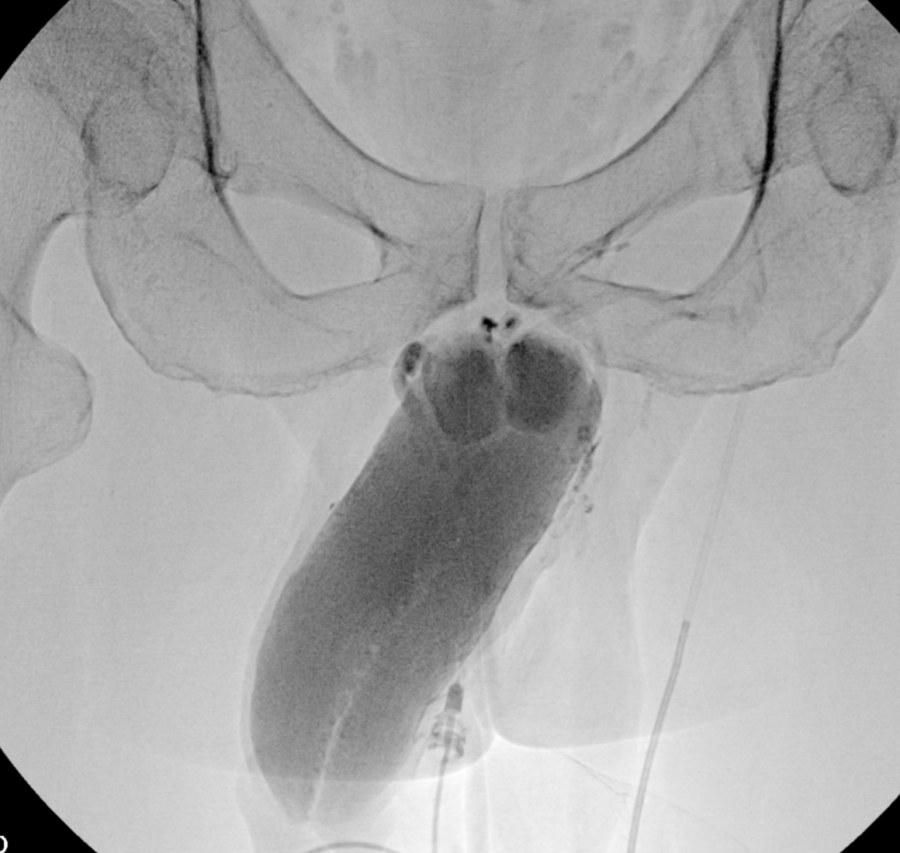
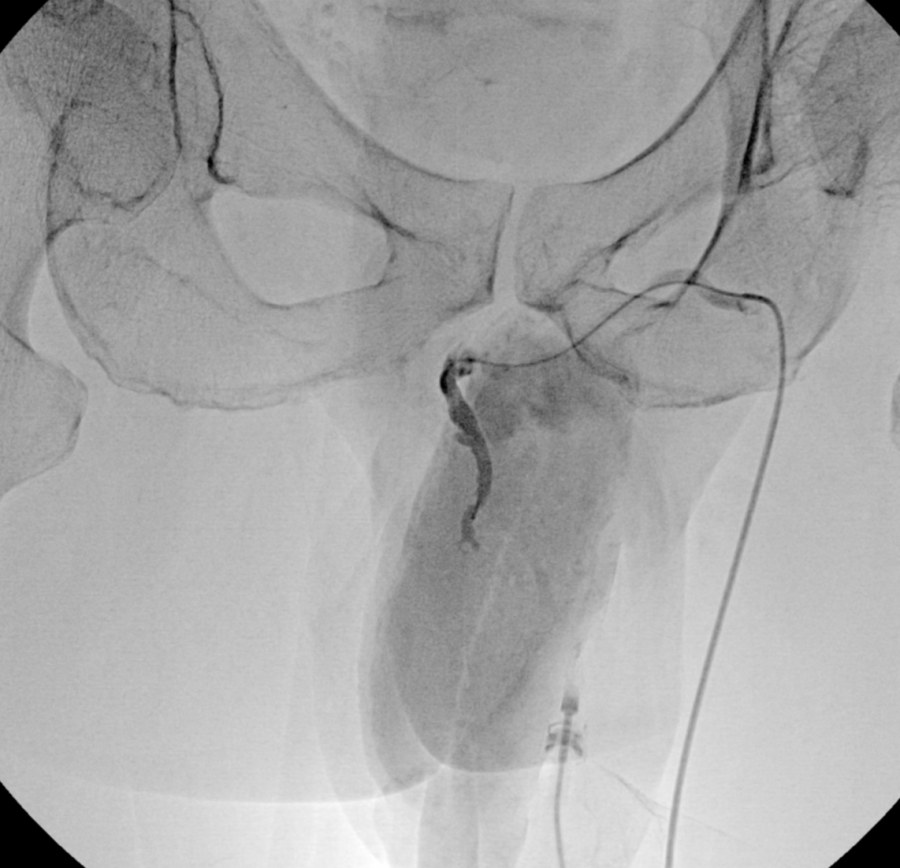
Procedural images from a patient treated at this practice, reproduced with permission. Individual results vary.
What to expect on the day
When you arrive, our team will get you comfortable and start an IV. You will be given “twilight” sedation, so you will be relaxed and sleepy but breathing on your own, with no breathing tube and no general anesthesia.
The procedure itself typically takes one to two hours. Afterward you will rest in our recovery room for about an hour while the sedation wears off. Because there are no major incisions, you go home the same day.
Recovery
Recovery is brief. On day one, plan to rest at home. You may have mild soreness at the access site and a mild ache in the pelvic area. This is easily managed with ice and over-the-counter pain relievers such as ibuprofen or acetaminophen.
By the end of the first week most men feel back to normal. You can typically return to a desk job or light duties within one to two days. We ask that you avoid heavy lifting, strenuous exercise, and sexual activity for 7 to 14 days, so the treated veins heal properly.
What is normal, and when to call
Mild bruising at the entry site and a temporary ache are completely normal. Call our office if you experience severe or worsening pain, a fever above 101°F, or active bleeding.
Risks and considerations
Venous leak embolization is highly safe, but there are potential risks.
Common, minor side effects include bruising at the access site and mild pelvic discomfort, which usually settles within a few days.
Rare but more serious risks include infection, injury to the blood vessel, or migration of the coils to another part of the body. Because the procedure is performed by a highly trained interventional radiologist using real-time imaging, the risk of vessel injury or coil migration is extremely low. If a complication does occur, we are fully equipped to manage it immediately.
Results and evidence
Dr. Golowa has performed hundreds of venous leak embolizations with excellent success rates, among the highest volumes in the United States for this procedure.
Patients travel to this practice from across the country and from overseas specifically for this treatment with Dr. Golowa.
The clinical evidence supports venous leak embolization as a viable option for men with confirmed veno-occlusive dysfunction. Studies report a technical success rate (successfully blocking the target veins) of over 95%.
Clinical success, meaning an erection sufficient for intercourse, varies with the severity of the leak and with underlying health conditions. Studies show significant improvement in up to 75% of carefully selected patients.
For some men, embolization restores natural function completely. For others, it makes previously ineffective oral medication such as Viagra or Cialis work again.
Common questions
- Is it painful?
- The procedure is well tolerated. IV sedation keeps you relaxed and sleepy, and you will not feel the catheter moving inside your body. Afterward you may have mild pelvic or groin aches for a few days, easily managed with over-the-counter pain medicine.
- Will insurance cover it?
- Coverage varies widely. While this is a recognised medical treatment for diagnosed erectile dysfunction, some carriers consider venous leak embolization experimental, and others offer only partial coverage. We will work with your insurance provider to establish your exact benefits and any out-of-pocket cost before you proceed.
- How soon will I notice a difference?
- Most men notice improvement as soon as they are cleared to resume sexual activity, typically two weeks after the procedure. It may take a few more weeks for minor post-procedure swelling to settle completely and for you to see the full result.
- What happens if it doesn’t work?
- In some cases the body forms new collateral veins over time and the leak returns. If that happens, the embolization can sometimes be repeated. If it is ultimately unsuccessful, every other treatment option remains available to you, including penile implant surgery, which offers a permanent and highly reliable solution.