Overview
Millions of adults live with the discomfort, itching, and bleeding of internal hemorrhoids. When conservative measures such as dietary changes and topical creams fail, many patients fear that painful traditional surgery is the only option left.
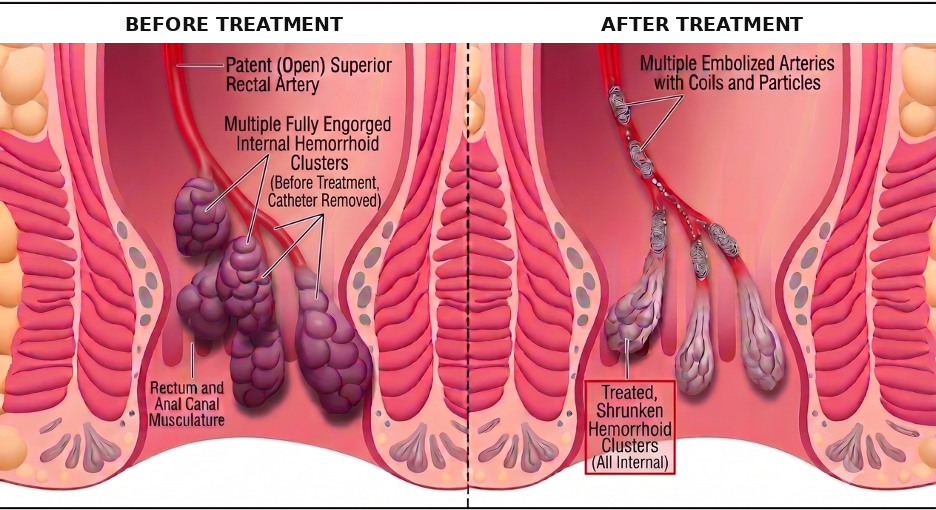
Hemorrhoid embolization, also known as hemorrhoidal artery embolization (HAE), is a minimally invasive alternative that shrinks enlarged hemorrhoids without surgery. Instead of cutting the hemorrhoidal tissue away, the procedure works by selectively reducing the blood supply that feeds the inflamed vessels.
It provides long-lasting relief from hemorrhoidal bleeding and discomfort, without the painful, prolonged recovery and the risks that come with traditional hemorrhoid surgery.
The procedure takes about 45 minutes, and most patients return to their usual activities the next day. To find out whether you are a candidate, call our office at (212) 991-9991.
Who it’s for
Most patients considering this procedure come to the clinic with chronic, symptomatic internal hemorrhoids. They typically have painless but significant rectal bleeding during bowel movements, or chronic itching, prolapse, and a constant feeling of fullness. Most have already tried over-the-counter treatments, a high-fibre diet, or even rubber band ligation without lasting relief.
A consultation and a brief physical exam or anoscopy are usually needed to confirm the grade of your hemorrhoids and to make sure you are a good candidate for the procedure.
Who is not a candidate
If your main problem is strictly external hemorrhoids or an acute anal fissure, or if you have a severe grade 4 prolapse that cannot be manually reduced, embolization may not be the best first treatment. In those cases we will direct you to the appropriate colorectal specialist for your care.
How the procedure works
1. Accessing the artery
An interventional radiologist cleans and numbs a small area at the top of the thigh. A tiny tube called a catheter is inserted through a small needle puncture access into the artery.
2. Navigation and imaging
Using real-time X-ray guidance (fluoroscopy), the catheter is navigated through your blood vessels directly to the superior rectal artery, which supplies the hemorrhoids. You will not feel this happening inside your body.
3. Embolization: blocking the vessels
Once the catheter is precisely positioned, tiny platinum coils or microscopic particles are deployed into the specific branches feeding the hemorrhoids. This safely reduces the blood flow and relieves the high pressure inside the engorged vessels.
4. Shrinkage and relief
Deprived of their excess blood supply, the hemorrhoids shrink and the bleeding stops. The healthy tissue of the rectum keeps an adequate blood supply through collateral arteries. The catheter is removed and a simple bandage is applied.
What to expect on the day
When you arrive, our team will get you comfortable and start an IV. You will be given “twilight” sedation, so you will be relaxed and sleepy but breathing on your own, without general anesthesia.
The procedure itself typically takes 45 minutes to an hour. Afterward you will rest in our recovery room for about an hour while the sedation wears off. Because there are no surgical incisions in the sensitive anal area, you go home the same day.
Recovery
Recovery is remarkably manageable, particularly compared with traditional hemorrhoid surgery. On day one, plan to rest at home. You may have mild soreness at the access site. Unlike a surgical hemorrhoidectomy, this procedure does not leave you with severe pain during bowel movements afterward.
By the next day most patients feel completely back to their baseline. You can typically return to a desk job and normal daily activities within 24 to 48 hours. We ask that you avoid heavy lifting and strenuous exercise for about a week so the access site heals properly.
What is normal, and when to call
Mild bruising at the entry site is completely normal. Call our office if you experience severe or worsening abdominal pain, a fever above 101°F, active bleeding at the access site, or any sign of infection.
Risks and considerations
Hemorrhoidal artery embolization is highly safe, but as with any procedure there are potential risks, and we would rather set them out plainly.
Common, minor side effects include mild bruising at the catheter insertion site, and temporary spotting of blood from the rectum in the first few days as the tissue adjusts.
Rare but more serious risks include pelvic infection, injury to the blood vessel, and reduced blood flow to healthy rectal tissue. Because the procedure is performed by a highly trained interventional radiologist using advanced imaging, the risk of major complications is extremely low.
Results and evidence
The clinical evidence supporting embolization for internal hemorrhoids is excellent. Studies show a technical success rate of nearly 100%, meaning the targeted arteries can almost always be blocked successfully.
For symptom relief, 70% to 85% of patients experience a significant and lasting improvement in hemorrhoidal bleeding and prolapse.
Because the procedure involves no cutting and removes no tissue, the anal sphincter is never touched, so it does not carry the risk of anal incontinence that traditional surgery does.
Common questions
- Is it painful?
- The procedure is well tolerated and painless. We numb the entry site with local anesthesia and provide IV sedation to keep you relaxed. Because no tissue is cut in the highly sensitive anal canal, patients avoid the difficult recovery traditionally associated with hemorrhoid surgery.
- Will insurance cover it?
- Hemorrhoid embolization is increasingly recognised as a highly effective treatment, though coverage can vary depending on your carrier and plan. Our office will work closely with your insurance provider to verify your exact benefits and out-of-pocket costs before you proceed.
- How soon will I notice a difference?
- Most patients notice a dramatic reduction in rectal bleeding within the first few days after the procedure. Symptoms of bulk and prolapse improve gradually over the next two to four weeks as the hemorrhoidal tissue shrinks and softens.
- What happens if it doesn’t work?
- If you do not have adequate relief after a few months, we will re-evaluate your condition. And if embolization ultimately does not relieve your symptoms, it does not compromise future treatment: you remain a full candidate for traditional colorectal procedures.