Overview
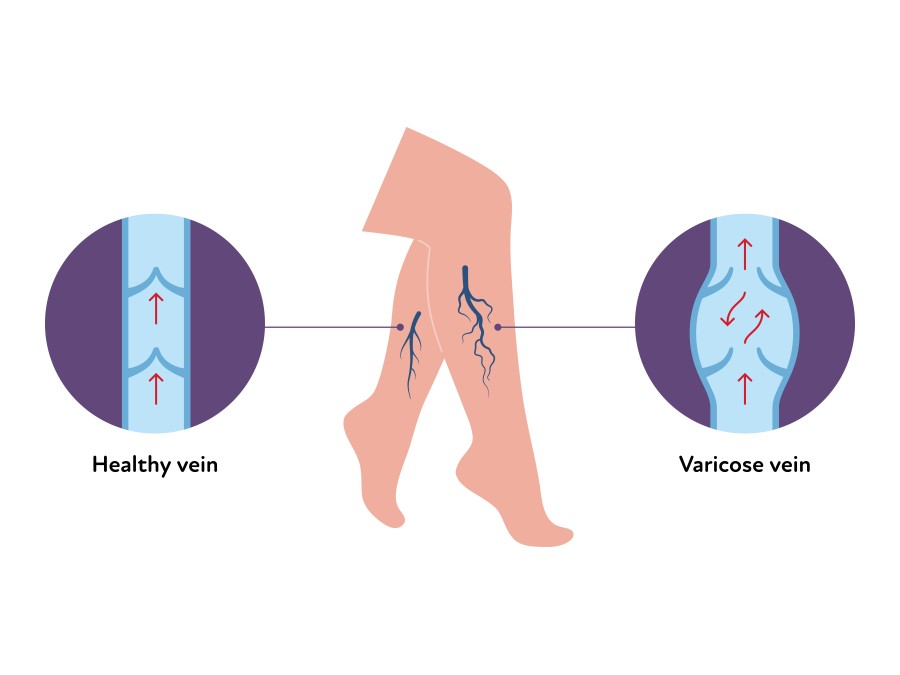
Varicose veins are the visible sign of a problem deeper in the leg. Inside your leg veins are one-way valves that keep blood moving upward toward the heart. When those valves fail, blood flows backward and pools, a condition called venous reflux. The pressure builds, and the veins near the surface stretch, twist, and bulge.
The result is rarely just cosmetic. Most patients describe aching, heaviness, throbbing, swelling by the end of the day, night cramps, restless legs, and itching. Left untreated over years, the pressure can lead to skin discolouration around the ankle, hardening of the skin, and eventually venous ulcers.
Modern treatment closes the failed vein from the inside rather than stripping it out surgically. Once the faulty vein is sealed, blood immediately reroutes through healthy veins, the pressure falls, and the bulging surface veins fade. We use two main approaches, endovenous laser ablation (EVLT) and Varithena, and often a combination of the two.
Both are office-based, take under an hour, use only local anesthesia, and let you walk out and return to normal activity the same day.
Who it’s for
Most patients come to the clinic because of aching, heavy, or swollen legs that are worse at the end of the day or after standing, along with visible bulging veins. Others come because of night cramps, restless legs, skin changes at the ankle, or a vein that has bled or become inflamed. Many have already tried compression stockings, elevation, and over-the-counter remedies without lasting relief.
A duplex ultrasound of the leg is used to confirm the diagnosis. It is painless, takes about 30 minutes, and maps exactly which veins have failed and in which direction the blood is flowing. That map determines which treatment is right for you, and no treatment is planned without it.
Who is not a candidate
If you have an active deep vein thrombosis, treatment is deferred until that is managed. If the deep veins themselves are blocked and the surface veins are carrying the blood around the blockage, closing them would do harm rather than good, which is another reason the ultrasound map comes first. Pregnancy is a reason to wait, since many pregnancy-related varicose veins improve on their own in the months after delivery.
How the procedure works
1. Mapping the veins
Every treatment begins with the duplex ultrasound map. It shows which vein is leaking, where the reflux starts, and how the surface veins connect to it. Treating a bulging vein without closing the failed vein feeding it is the most common reason varicose veins come back.
2. Endovenous laser ablation (EVLT)
EVLT treats a straight, larger failed vein, most often the great or small saphenous vein. The skin over the vein is numbed, and a thin laser fibre is passed into the vein through a small needle puncture access. Dilute local anesthetic is then placed around the vein, which numbs it completely and protects the surrounding tissue. As the fibre is withdrawn, laser energy heats the vein wall and seals it closed. The whole treatment takes about 30 to 45 minutes.
3. Varithena
Varithena is a prepared polidocanol microfoam, injected into the vein through a small catheter or needle under ultrasound guidance. The foam fills the vein, displaces the blood, and irritates the vein lining so that it collapses and closes. Because foam travels where a laser fibre cannot, Varithena is particularly useful for veins that are twisted, branching, close to the skin, or recurring after previous treatment. No heat and no tumescent anesthetic are needed, and the injection itself takes only a few minutes.
4. Treating the surface veins
Once the underlying reflux is closed, many bulging surface veins shrink on their own. Any that remain can be treated in a short follow-up visit, either with foam sclerotherapy or by removing them through pinhole punctures that need no stitches.
Which one is right for you
This is decided from your ultrasound, not from a preference for one technology. Straight truncal veins usually suit EVLT. Tortuous, superficial, or recurrent veins usually suit Varithena. Many legs need both, and they can often be done in the same visit.
What to expect on the day
These are office-based treatments. You will be awake throughout, with local anesthesia only, and there is no need for sedation or general anesthesia. You can eat normally beforehand and take your usual medications.
The treatment itself typically takes 30 to 45 minutes. You will rest in our recovery room for about an hour afterward.
A compression stocking is fitted on the treated leg before you leave, and we will ask you to walk for 10 to 20 minutes before going home. Walking is part of the treatment, not a restriction.
Recovery
There is no downtime in the usual sense. You walk immediately, and most patients return to work and normal activity the same day or the next. We ask you to wear the compression stocking as directed, usually for one to two weeks, and to walk regularly rather than sit or stand still for long stretches.
In the first week or two the treated vein often feels tight, tender, or cord-like along its length, and some bruising is normal. This settles steadily. Avoid heavy lifting, long flights, and hot baths or saunas for about two weeks. Most people are back to full exercise within two weeks.
The cosmetic result develops gradually. The aching and heaviness usually improve within days, but the visible veins fade over weeks to a few months as the body reabsorbs the closed vein.
What is normal, and when to call
Tightness along the vein, bruising, and mild tenderness are expected. Call our office if you develop increasing pain and swelling of the whole calf or thigh, redness spreading up the leg, shortness of breath or chest pain, a fever above 101°F, or any sign of infection at a puncture site.
Risks and considerations
Both treatments are highly safe and have been performed for many years, but as with any procedure there are potential risks, and we would rather set them out plainly.
Common, minor effects include bruising, tenderness and tightness along the treated vein, temporary skin discolouration over the vein, and small areas of numbness where a nerve runs alongside it. These almost always resolve.
Rare but more serious risks include infection at a puncture site, superficial phlebitis, and deep vein thrombosis. The risk of a clot extending into the deep system is low, and we reduce it further with immediate walking, compression, and a follow-up ultrasound after treatment. With Varithena specifically, transient visual disturbance or headache can occur shortly after the injection and resolves on its own.
Results and evidence
Both approaches are well studied. In the published comparisons, endovenous laser ablation and Varithena eliminate reflux at broadly similar rates, on the order of 93% of treated veins, and a network meta-analysis of thirteen studies found no statistically significant difference between polidocanol microfoam and endovenous thermal ablation for vein closure.
Symptom relief tends to run ahead of appearance. Most patients report that the aching and heaviness are noticeably better within the first week or two, well before the visible veins have finished fading.
Closed veins do not reopen in most patients, but varicose veins are a chronic condition rather than a one-off event. New veins can develop over the years, particularly with a strong family history, which is why we recommend continued compression during long travel or long days on your feet, and a follow-up ultrasound if symptoms return.
Common questions
- Is it painful?
- Both treatments are done under local anesthesia and are well tolerated. With EVLT you feel the initial pinprick and some pressure as the numbing fluid is placed around the vein, but not the laser itself. Varithena involves little more than a needle stick. Afterward the leg usually feels tight rather than painful, and over-the-counter pain relievers are enough.
- Will insurance cover it?
- Usually yes. When varicose veins are causing symptoms such as pain, swelling, or skin changes, and the ultrasound documents reflux, treatment is considered medically necessary and is covered by Medicare and most major carriers. Most insurers require a trial of compression stockings first. Purely cosmetic treatment of spider veins is not covered. Our office will verify your exact benefits before you proceed.
- Do I have to wear compression stockings?
- Yes, for a period after treatment, usually one to two weeks. They reduce bruising and tenderness, help the vein stay closed, and lower the risk of a clot. Most insurers also require a documented trial of stockings before approving treatment.
- What if my veins come back?
- The treated vein stays closed in the large majority of patients. What can happen over the years is that a different vein fails, which is the nature of a chronic condition rather than a failure of the treatment. If symptoms return we repeat the ultrasound, find the source, and treat it, often with a short foam session.