Overview
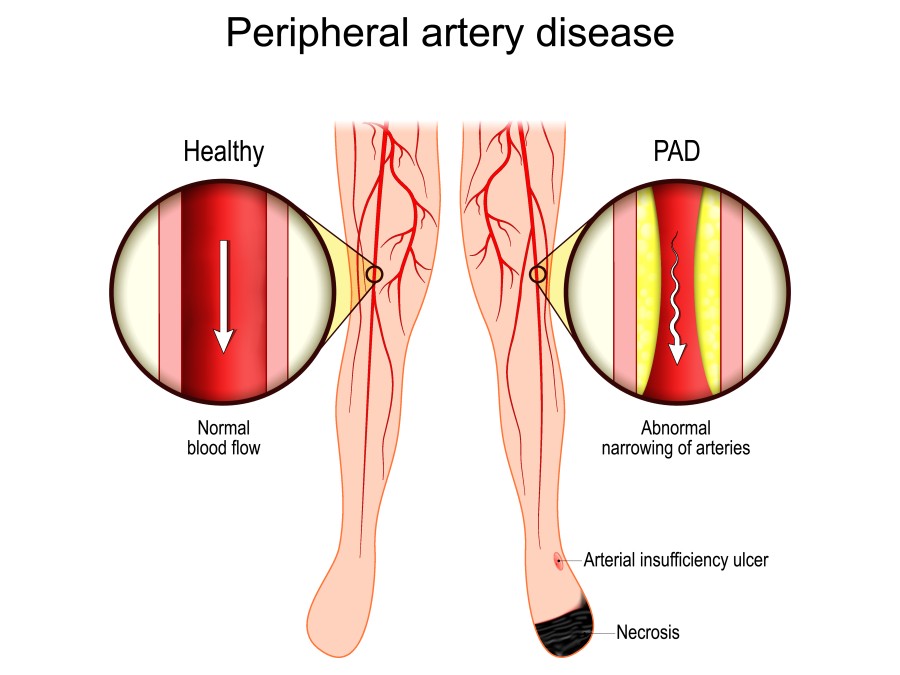
Peripheral artery disease (PAD) is the narrowing of the arteries that carry blood to your legs, caused by the gradual build-up of plaque. As the arteries narrow, the muscles cannot get the blood they need, and the leg begins to signal it.
The classic symptom is claudication: a cramping, aching, or tired feeling in the calf, thigh, or buttock that comes on after walking a predictable distance and goes away with a few minutes of rest. As the disease advances, pain can appear at rest, particularly at night, and wounds on the foot or toes stop healing.
Endovascular treatment reopens the artery from the inside, through a needle puncture rather than an incision. Depending on what the artery looks like, that may mean stretching the narrowing open with a balloon, shaving the plaque away, delivering medication into the artery wall to keep it open, or placing a stent to hold it open.
It restores blood flow to the leg, relieves the cramping that limits how far you can walk, helps wounds heal, and in advanced disease it is what saves the limb, without open bypass surgery and with a recovery measured in days.
Who it’s for
Most patients come to the clinic because walking has become limited. They can predict the distance at which the cramping starts, and they have begun planning routes and errands around it. Others come with pain in the foot at night that is relieved by hanging the leg over the side of the bed, with a toe or heel wound that will not heal, or after an abnormal result on a screening test.
Diagnosis begins with pulses and an ankle-brachial index, a simple blood pressure comparison between the ankle and the arm. Duplex ultrasound, CT angiography, or MR angiography then show exactly where the narrowing is and how long it is. Treatment is planned from that map.
PAD is also a warning about the arteries elsewhere in the body. Patients with PAD are at higher risk of heart attack and stroke, so alongside treating the leg we will make sure the medical side is addressed: cholesterol and blood pressure control, diabetes management, antiplatelet therapy, and above all stopping smoking, which does more for the leg than any procedure.
Who is not a candidate
Not every leg symptom is arterial. Pain that is present at rest and eased by walking, or that changes with position and comes with back symptoms, often points to spinal stenosis rather than PAD, and a stent will not help it. For mild claudication, a supervised exercise programme and medical therapy are the right first step and can be as effective as a procedure. Very long, heavily calcified blockages, or advanced tissue loss, sometimes need surgical bypass, and in those cases we work with vascular surgery to get you the right operation.
How the procedure works
1. Accessing the artery
An interventional radiologist cleans and numbs a small area, usually at the top of the thigh, sometimes at the arm or the foot depending on where the blockage sits. A tiny tube called a catheter is inserted through a small needle puncture access into the artery.
2. The angiogram
Contrast is injected and X-ray images map the arteries of the leg in real time, showing each narrowing and blockage and, just as importantly, the vessels below it that will receive the restored flow. You will not feel the catheter moving inside your body.
3. Crossing and opening the blockage
A fine guidewire is steered across the narrowed segment. A balloon is then advanced over it and inflated for a short time to open the artery. You may feel a brief pressure or ache in the leg while the balloon is up, which settles as soon as it comes down.
4. Keeping it open
Some arteries stay open with the balloon alone. Others do better with additional treatment: atherectomy, which shaves or sands the plaque away; a drug-coated balloon, which leaves medication in the artery wall to discourage the narrowing from returning; or a stent, a small metal mesh tube that acts as a scaffold. The choice is made during the procedure, based on how the artery responds. A final angiogram confirms the restored flow, the catheter is removed and pressure or a closure device is applied.
What to expect on the day
When you arrive, our team will get you comfortable and start an IV. The procedure is done under local anesthesia at the access site, with light sedation to keep you relaxed. You stay awake and breathing on your own, without general anesthesia.
The procedure itself typically takes one to two hours, depending on how many segments need treating. You will rest in our recovery room for about an hour afterward, and we will check the pulses and circulation in your foot before you leave.
Because there are no incisions, you go home the same day in most cases. If the blockage was complex, or if you have a wound being treated, we may keep you overnight.
Recovery
On day one, plan to rest at home and keep the access site dry. You may have mild soreness or bruising there. Many patients notice the difference in their walking almost immediately, and some describe the leg feeling warmer within hours.
Most patients return to normal daily activities within two to three days. We ask you to avoid heavy lifting and strenuous exercise for about a week so the access site heals. After that, walking is actively encouraged: regular walking improves the collateral circulation and helps keep the treated artery open.
You will be prescribed an antiplatelet medication, and if a stent was placed you may be on two of them for a period. Taking them as prescribed is the single most important thing you can do to keep the artery open. We will see you for follow-up with ultrasound to confirm the artery is staying open.
What is normal, and when to call
Mild bruising and tenderness at the access site are expected. Call our office immediately if the leg or foot becomes cold, pale, numb, or newly painful, if there is bleeding or a rapidly growing swelling at the access site, if a wound worsens, or if you develop a fever above 101°F.
Risks and considerations
Endovascular treatment of PAD is well established and highly safe, but as with any procedure there are potential risks, and we would rather set them out plainly.
Common, minor effects include bruising and tenderness at the access site.
Rare but more serious risks include bleeding or a collection of blood at the access site, injury to the artery, a clot or fragment of plaque travelling downstream, infection, and a temporary effect on kidney function from the contrast, which we minimise with hydration and by using as little contrast as possible. Because the procedure is performed by a highly trained interventional radiologist using advanced, real-time imaging, the risk of major complications is low, and our team is equipped to manage them immediately if they arise.
One consideration is honest to state: this treats the blockage, not the underlying disease. Arteries can narrow again, particularly in smokers and in patients with diabetes. Medication, exercise, and stopping smoking are what make the result last.
Results and evidence
Endovascular treatment for PAD is supported by a large body of evidence and is now the first-line approach for most patients. Technical success, meaning the blockage is crossed and flow is restored, is achieved in the great majority of cases.
For patients with claudication, the typical result is a substantial increase in pain-free walking distance and a return to activities that had been given up. For patients with rest pain or a non-healing wound, restoring flow is what allows the wound to heal and the limb to be saved.
Durability depends on where the disease is and what was used to treat it. Larger arteries in the thigh tend to stay open longer than the small arteries below the knee, and drug-coated balloons and stents have improved how long the result lasts. Follow-up surveillance matters: a narrowing found early on ultrasound can usually be re-treated with a simple repeat balloon, before it becomes a blockage again.
Common questions
- Is it painful?
- The procedure is well tolerated. We numb the access site with local anesthesia and provide light sedation to keep you relaxed, and you will not feel the catheter moving inside your body. You may feel a brief ache or pressure in the leg while the balloon is inflated, which passes within seconds. Afterward the access site may be tender for a few days.
- Will insurance cover it?
- Yes. Peripheral artery disease is a recognised medical condition, and treatment for symptomatic disease is covered by Medicare and most major carriers. Our office will verify your exact benefits before you proceed.
- Will I need a stent?
- Not necessarily. Many arteries stay open with a balloon alone or with a drug-coated balloon, and we prefer to leave nothing behind where we can. A stent is used when the artery recoils, when there is a flap of tissue that needs holding down, or when the segment is long. The decision is made during the procedure based on how the artery behaves.
- How soon will I be able to walk further?
- Many patients notice a difference within days. The improvement often continues over the following weeks as you walk more, which itself builds circulation. A structured walking programme after treatment produces better results than the procedure alone.
- What happens if it narrows again?
- It can be re-treated. Repeat narrowing is usually found on surveillance ultrasound before symptoms return, and it can generally be reopened with another balloon, often more easily than the first time. Having had endovascular treatment does not prevent bypass surgery later if it ever becomes necessary.